
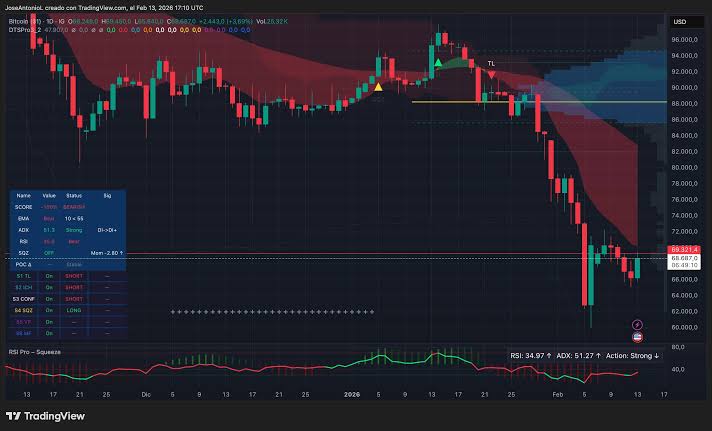
Bitcoin took a massive hit during late-night trading, crashing straight through the sixty-two thousand dollar support line to find its lowest price point in over four months. The sudden drop completely caught over-leveraged traders off guard, setting off a domino effect of forced liquidations across major digital asset exchanges worldwide.
If you talk to market analysts, they will tell you this is the result of a bad mix of global economic pressures and growing geopolitical instability. Over the last twenty-four hours, military actions and hostile statements in the Middle East have escalated, causing global markets to rush into safety mode. Investors pulled their cash out of volatile assets and dumped it straight into safe havens like gold and the US dollar. On the flip side, riskier assets took the brunt of the damage. Cryptocurrencies and high-growth tech stocks were heavily sold off as everyone tried to de-risk at the exact same time.
To make matters worse, this geopolitical anxiety is happening right alongside a big shift in how big institutions are handling their crypto. Data from earlier this week shows that Bitcoin spot ETFs just wrapped up their worst month of the entire year. Traditional fund managers have been pulling their money out in massive net redemptions, choosing to scale back their digital asset exposure because they expect interest rates to stay high for a lot longer than initially hoped.
When you look at the technical side of the charts, breaking below sixty-two thousand dollars opens up the sandbox for even more downward drops. Order books on major exchanges are looking pretty thin right now, meaning there are not a lot of buyers waiting to step in. In fact, the next big historical cluster of buy orders does not even show up until you get down to the fifty-eight thousand five hundred dollar range. The derivatives markets are feeling the worst of this pain. Liquidations on long positions have easily crossed the billion-dollar mark, turning this into a brutal correction that is rapidly flushing out the leverage.
This shift in mood is a far cry from the optimistic tones we saw not too long ago. Just a few weeks back, the market was buzzing with talks of a clean recovery, but the sentiment has flipped entirely. Prediction markets are reflecting this defensive posture. On platforms like Kalshi and Polymarket, traders are aggressively hedging their bets, with a growing majority betting that prices will stay depressed through the rest of the month.
What is particularly interesting about this drop is how isolated it feels from certain parts of traditional finance. While US equities and AI-linked tech stocks have managed to hold their ground relatively well, crypto has decoupled, acting as the ultimate gauge for raw risk appetite. When headlines about regional conflicts and halted diplomatic talks hit the wires, crypto traders tend to shoot first and ask questions later.
For everyday investors, the question now is where the bottom actually sits. Some analysts argue that the core fundamentals of the network remain completely unchanged and that these flushes are just a healthy, albeit painful, part of the market cycle. They look at past corrections where similar geopolitical shocks caused temporary drops, only for the market to stabilize once the initial panic subsided.
However, the presence of heavy institutional money through ETFs adds a new variable to the equation. Unlike the retail-driven markets of previous years, the current landscape is deeply tied to the macro decisions of asset managers who answer to strict risk parameters. If these large entities continue to see reasons to de-risk, the lack of immediate buying pressure could prolong the stagnation. For now, the market is trapped in a waiting game, keeping a very close eye on the next round of inflation numbers and central bank meetings to see which way the wind will blow next.
READ ALSO
- Will Crypto Ever Recover? The Real Reason Prices Are Crashing in 2026
- Shocks Crypto Market With Sudden $2.5 Million Corporate Bitcoin Liquidation
- Bitcoin Spot ETFs Experience Worst Month of 2026 With Record $2.43 Billion Outflows
- Crypto Longs Liquidation Exceeds $1.5 Billion in 24 Hours as Market Sell-Off Intensifies