
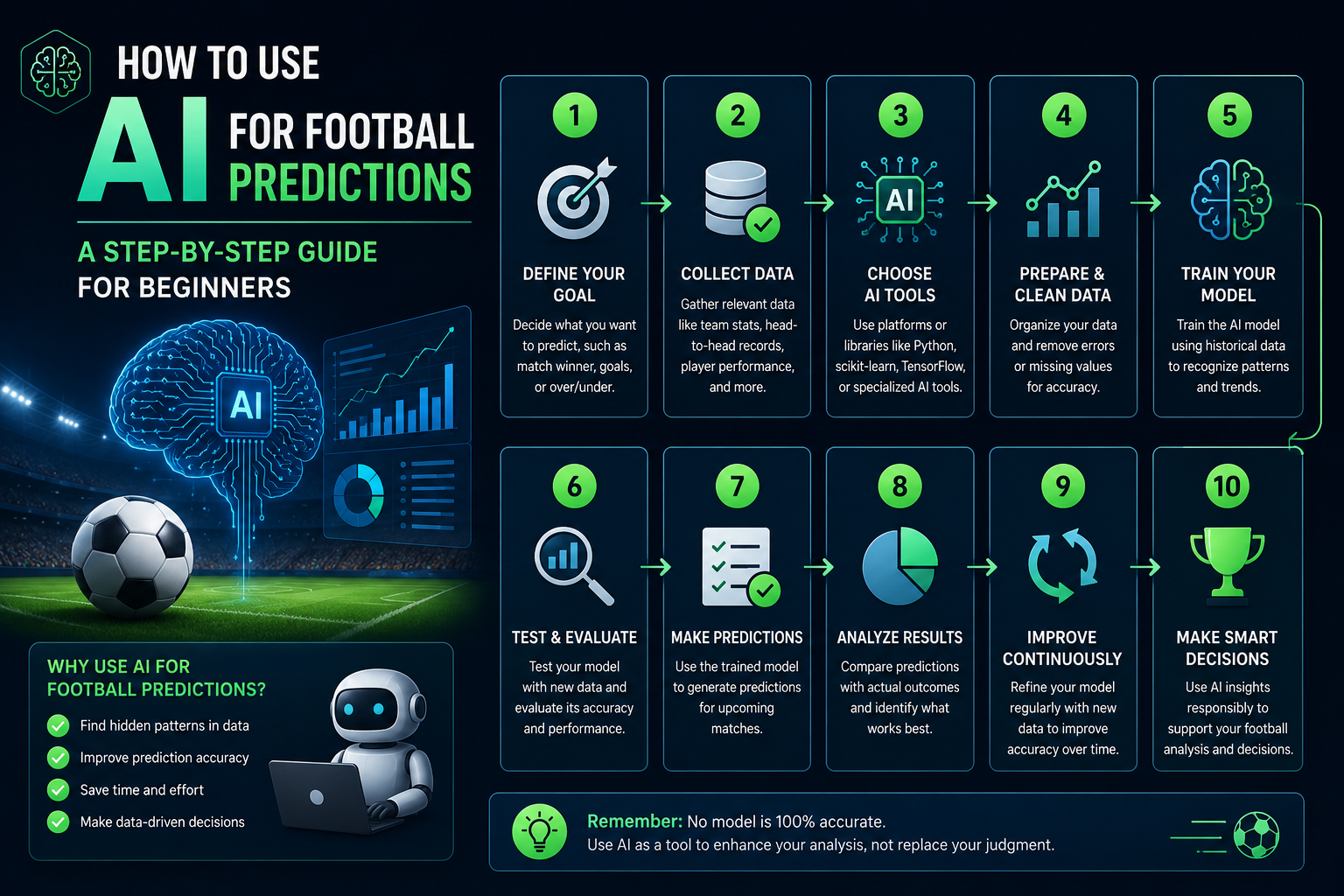
Football prediction has changed significantly over the last few years. What once relied mostly on expert opinions, newspaper columns, and personal judgment now involves large amounts of data processed in seconds. One of the biggest reasons for this shift is the growing use of artificial intelligence (AI).
Today, AI tools can analyze team performance, player statistics, historical results, injuries, and many other factors to help users make more informed football predictions. Whether you're a football fan, fantasy football player, sports analyst, or bettor, AI can provide valuable insights that would be difficult to uncover manually.
However, it is important to understand that AI is not a magic solution that guarantees correct predictions. Football remains unpredictable, and no tool can accurately forecast every match. Instead, AI should be viewed as a research tool that helps you identify patterns and trends before making a decision.
In this guide, you'll learn how AI football predictions work, which data matters most, and how beginners can use AI tools effectively.
What Is AI in Football Predictions?
AI refers to computer systems that analyze data and identify patterns. In football, AI tools examine thousands of data points from previous and current matches to estimate the probability of certain outcomes.
For example, an AI system may analyze:
- Team form over the last five matches
- Goals scored and conceded
- Home and away records
- Head-to-head history
- Possession statistics
- Shots on target
- Expected goals (xG)
- Player injuries
- Suspensions
- Recent transfers
The system then uses this information to estimate possible outcomes such as:
- Home win
- Draw
- Away win
- Both teams to score
- Over or under goals
- Correct score probabilities
Rather than making a simple prediction, most AI tools provide probabilities that help users understand how likely an outcome is.
Why Are AI Football Predictions Becoming Popular?
There is simply too much football data available today for most people to analyze manually.
Consider a typical Premier League match. A user may need to review:
- Team form
- Injury reports
- Home and away records
- Goal-scoring trends
- Defensive performance
- Tactical changes
- Historical meetings
Doing this manually for several matches every week can take hours.
AI tools can process this information almost instantly and present it in a clear format. This allows users to spend more time interpreting the data rather than collecting it.
If you're looking for a reliable prediction site online, you can check out one of the best prediction site online in 2026
RECOMMENDED
Step 1: Choose the Right AI Football Prediction Tool
The first step is selecting an AI platform that suits your needs.
Some tools focus only on match predictions, while others provide deeper statistical analysis.
When comparing AI football tools, look for:
- Coverage of your preferred leagues
- Probability-based predictions
- Team and player statistics
- Injury updates
- Historical match data
- Easy-to-understand reports
- Regular data updates
A good AI tool should explain why a prediction was made rather than simply presenting a final result.
Step 2: Understand the Data Behind the Predictions
One of the biggest mistakes beginners make is blindly trusting predictions without understanding the underlying data.
Before relying on an AI forecast, examine the factors influencing the prediction.
READ ALSO
Team Form
Recent performance is often one of the strongest indicators of future results.
Questions to consider include:
- How many matches has the team won recently?
- Are they scoring consistently?
- Are they conceding many goals?
A team that has won four of its last five matches may have a stronger outlook than a team struggling for results.
Home and Away Performance
Some clubs perform much better at home than away.
For example:
- Team A may win 80% of home matches.
- Team A may win only 20% of away matches.
AI systems frequently include this information when calculating probabilities.
Head-to-Head Records
Historical meetings between teams can reveal useful trends.
While past results do not guarantee future outcomes, they sometimes highlight tactical matchups that consistently favor one side.
Step 3: Learn to Read Probability Percentages
Most AI prediction tools present results as percentages.
For example:
- Home Win: 50%
- Draw: 28%
- Away Win: 22%
Many beginners misunderstand these numbers.
A 50% probability does not mean the home team will definitely win. It simply means the AI believes the home team has the highest chance among the possible outcomes.
Probabilities help you compare outcomes rather than predict certainty.
Step 4: Check Team News Before Every Match
AI systems depend on available information.
If a key striker suffers an injury shortly before kickoff, some prediction models may not immediately adjust.
Before making a prediction, review:
- Injured players
- Suspended players
- Squad rotation
- Manager comments
- Travel schedules
- Fixture congestion
A team missing several important players may perform very differently from what historical statistics suggest.
Step 5: Compare Predictions from Multiple Sources
No AI model is perfect.
Different systems use different methods, data sources, and calculation techniques.
A smart approach is to compare several sources.
For example:
- AI prediction platform
- Football statistics website
- Expert match previews
- Team news reports
When multiple sources point toward the same conclusion, you may have greater confidence in your analysis.
Step 6: Use Expected Goals (xG) Data
Expected Goals, commonly called xG, has become one of the most useful football statistics.
xG estimates the quality of scoring chances created during a match.
For example:
- A penalty usually has a high xG value.
- A long-range shot usually has a lower xG value.
AI models often use xG because it provides a better picture of performance than final scores alone.
A team may lose a match 1-0 despite creating several high-quality chances. Looking only at the score could be misleading, while xG data reveals how the team actually performed.
Step 7: Identify Long-Term Trends
One match rarely tells the full story.
AI tools are particularly useful for identifying patterns over weeks or months.
Examples include:
- Teams that consistently score first
- Teams that struggle against top opponents
- Clubs with strong defensive records
- Teams involved in high-scoring matches
Long-term trends often provide more reliable insights than focusing on a single game.
Step 8: Avoid Emotional Decision-Making
Many football fans allow personal preferences to influence their predictions.
Common examples include:
- Supporting a favorite team
- Disliking a rival club
- Overreacting to one recent result
AI analysis can help reduce emotional bias by focusing on objective data.
This doesn't mean the AI is always correct, but it can provide a more balanced perspective than personal opinions alone.
Common AI Football Prediction Metrics
AI football prediction tools rely on various statistics to evaluate teams and estimate possible match outcomes. Understanding these metrics can help you interpret predictions more effectively rather than simply accepting the final result.
1. Possession Percentage
Possession percentage measures how much time a team controls the ball during a match. Teams with higher possession often create more scoring opportunities, although possession alone does not guarantee success. AI models use this metric to assess a team's ability to control games and dictate the pace of play.
2. Shots on Target
Shots on target indicate how often a team forces the goalkeeper to make a save or scores a goal. A team that consistently records a high number of shots on target is usually creating quality attacking opportunities. AI systems use this data to evaluate a team's attacking strength and scoring potential.
3. Goal Difference
Goal difference is calculated by subtracting goals conceded from goals scored. A positive goal difference often reflects a balanced team that performs well both offensively and defensively. AI models consider this metric because it provides a quick snapshot of overall team performance.
4. Expected Goals (xG)
Expected Goals, commonly known as xG, estimates the likelihood of a scoring chance resulting in a goal. It takes factors such as shot location, angle, and type of assist into account. Many analysts consider xG one of the most useful football metrics because it measures chance quality rather than actual goals scored.
5. Expected Goals Against (xGA)
Expected Goals Against measures the quality of chances a team allows its opponents to create. A low xGA value often indicates a strong defensive setup. AI models use this metric to identify teams that are difficult to break down even if recent results do not fully reflect their defensive performance.
6. Passing Accuracy
Passing accuracy measures how successfully a team completes passes. Teams with high passing accuracy tend to maintain possession more effectively and control matches. AI tools use this metric to evaluate a team's ability to build attacks and retain the ball under pressure.
7. Home and Away Performance
Many teams perform differently depending on where they play. Some clubs are dominant at home but struggle away from their own stadium. AI systems analyze separate home and away records because venue often has a significant impact on match outcomes.
8. Recent Form
Recent form looks at a team's performance over its last five to ten matches. This metric helps AI models identify momentum, confidence levels, and current playing conditions. Teams on winning streaks often perform differently from teams experiencing a run of poor results.
9. Head-to-Head Record
Head-to-head statistics examine how two teams have performed against each other in previous meetings. While football changes over time, certain tactical matchups can consistently favor one side. AI models may use this data to identify recurring patterns between specific teams.
10. Clean Sheet Percentage
This metric tracks how often a team prevents opponents from scoring. Teams with a high clean-sheet percentage are generally well organized defensively. AI systems often combine this data with xGA and goals conceded to assess defensive reliability.
Benefits of Using AI for Football Predictions
AI has become increasingly popular among football fans because it can process large amounts of information much faster than humans. While it cannot predict every result correctly, it offers several advantages that can improve the quality of your analysis.
1. Faster Data Analysis
One of the biggest advantages of AI is speed. Instead of manually reviewing statistics from multiple sources, AI tools can analyze thousands of data points in seconds. This allows users to spend more time evaluating insights and less time collecting information.
2. Identifies Hidden Patterns
AI excels at spotting trends that may not be obvious to the average football fan. It can detect long-term patterns in team performance, player contributions, and tactical approaches that might otherwise go unnoticed.
3. Reduces Emotional Bias
Many football fans make predictions based on loyalty to their favorite clubs or personal opinions. AI relies on data rather than emotions, helping users make more objective assessments of upcoming matches.
4. Improves Consistency
Human analysis can vary depending on mood, experience, or personal preferences. AI applies the same evaluation process to every match, creating a more consistent approach to prediction and analysis.
5. Saves Time
Researching multiple leagues and matches can be time-consuming. AI tools simplify this process by gathering and organizing relevant information in one place, making football analysis more efficient.
6. Provides Probability-Based Insights
Rather than offering simple win-or-lose predictions, AI tools often provide probability percentages for different outcomes. This gives users a clearer understanding of how likely each result may be and encourages more realistic expectations.
7. Supports Better Decision-Making
AI should not replace human judgment, but it can support it. By combining AI-generated insights with team news, injuries, and football knowledge, users can make more informed decisions when analyzing matches.
8. Covers Multiple Leagues Simultaneously
Following several leagues manually can be difficult. AI systems can track matches from different countries and competitions at the same time, helping users compare opportunities across a wider range of games.
9. Learns from New Data
Many modern AI systems continuously update their models as new information becomes available. This allows predictions to reflect recent performances, injuries, transfers, and other developments throughout the season.
10. Helps Beginners Understand Football Statistics
For newcomers, AI tools can serve as an introduction to football analytics. By presenting statistics in a structured and easy-to-understand format, they make advanced football analysis more accessible to beginners.
Limitations of AI Football Predictions
Although AI can be a valuable research tool, it is important to understand its limitations.
Football Remains Unpredictable
No AI model can account for every event that occurs during a match. Red cards, penalties, injuries, tactical changes, and unexpected moments can completely alter the outcome of a game.
Data Quality Matters
AI predictions are only as reliable as the data being used. Incomplete, outdated, or inaccurate information can reduce the quality of predictions.
Different Models Produce Different Results
Two AI platforms may generate different predictions for the same match because they use different datasets and calculation methods. This is why comparing multiple sources is often beneficial.
Predictions Are Probabilities, Not Guarantees
A team with a 70% chance of winning can still lose. AI helps estimate likelihoods, but it cannot predict the future with certainty.
Best Practices for Beginners
If you're just getting started with AI football predictions, these simple practices can help you get better results.
Use More Than One AI Tool
Comparing insights from multiple platforms can help you identify common trends and avoid relying too heavily on a single source.
Follow Team News Closely
Always check for injuries, suspensions, and lineup changes before making any prediction. These factors can significantly impact a team's chances.
Focus on Major Leagues
Top leagues generally have more reliable and complete data available, which often leads to better AI analysis.
Track Your Results
Keep a record of predictions and outcomes. Over time, this can help you identify which tools and methods work best for you.
Combine AI with Your Own Research
The most effective approach is usually a combination of AI insights, football knowledge, and current news. AI should assist your analysis, not replace it.
Conclusion
AI has made football analysis more accessible than ever before. By processing large amounts of data quickly, these tools can help users identify trends, compare teams, and understand the probabilities behind different match outcomes. For beginners, the key is to use AI as a support tool rather than a source of guaranteed predictions. When combined with football knowledge, current team news, and careful research, AI can become a valuable part of your football prediction process and help you make more informed decisions over time.