
Automated trading has become one of the most competitive areas of Web3. Whether you're running an arbitrage bot, a market-making strategy, or a high-frequency trading system, execution speed and transaction privacy can make the difference between profit and loss. Unfortunately, the same transparency that makes blockchains powerful also creates opportunities for bad actors to exploit your trades.
One of the biggest threats facing automated traders is front-running. Sophisticated bots constantly monitor pending transactions and attempt to profit from your activity before it reaches the blockchain. This is where private RPC nodes become extremely valuable. By routing transactions through private channels instead of public mempools, traders can significantly reduce their exposure to front-running and other forms of MEV exploitation.
What Is Front-Running in Crypto Trading?
Front-running occurs when someone detects your pending transaction and submits their own transaction ahead of yours. Their goal is to benefit from the market movement your trade is expected to create. While the concept has existed in traditional finance for years, blockchain transparency has made it particularly effective in decentralized markets.
Because most transactions are visible before they are confirmed, bots can analyze pending orders and identify profitable opportunities. If a large buy order is about to push a token's price higher, an attacker can buy first and then sell after your transaction executes. The profit comes directly from the price movement your trade helped create.
This process happens automatically and often within seconds. Most users never realize they have been front-run because the transaction still completes successfully. However, the final execution price is usually worse than expected, resulting in hidden costs that accumulate over time.
Understanding Sandwich Attacks
One of the most common forms of front-running is the sandwich attack. In this scenario, an attacker places one transaction before yours and another immediately after it. Your trade becomes the "filling" in the middle of the sandwich.
Imagine you're swapping a large amount of ETH for USDC. A bot detects your transaction and quickly purchases ETH before your order executes. Your trade pushes the price even higher, and the bot immediately sells the ETH at a profit after your swap is completed.
The result is simple: the bot earns money while you receive fewer tokens than expected. Although the loss on a single trade may seem small, repeated attacks can significantly impact the profitability of automated strategies.
Why Front-Running Remains a Problem in 2026
Many traders expected front-running to disappear as blockchain infrastructure matured. Instead, the problem has evolved. Better trading tools, more sophisticated bots, and faster networks have created an environment where competition for transaction ordering is more intense than ever.
On Ethereum and Layer 2 networks, builders and searchers continuously compete to extract value from transaction flow. On Solana, specialized execution systems and validator incentives have created their own ecosystem of MEV extraction. As trading volume grows, so does the incentive for attackers to exploit visible transactions.
This means automated traders must now think about transaction privacy just as seriously as they think about strategy design. A profitable trading algorithm can quickly become ineffective if competitors consistently exploit its activity before execution.
What Is a Private RPC Node?
A Remote Procedure Call (RPC) node acts as the connection point between your wallet, trading bot, and the blockchain. Whenever you submit a transaction, it typically passes through an RPC endpoint before reaching validators.
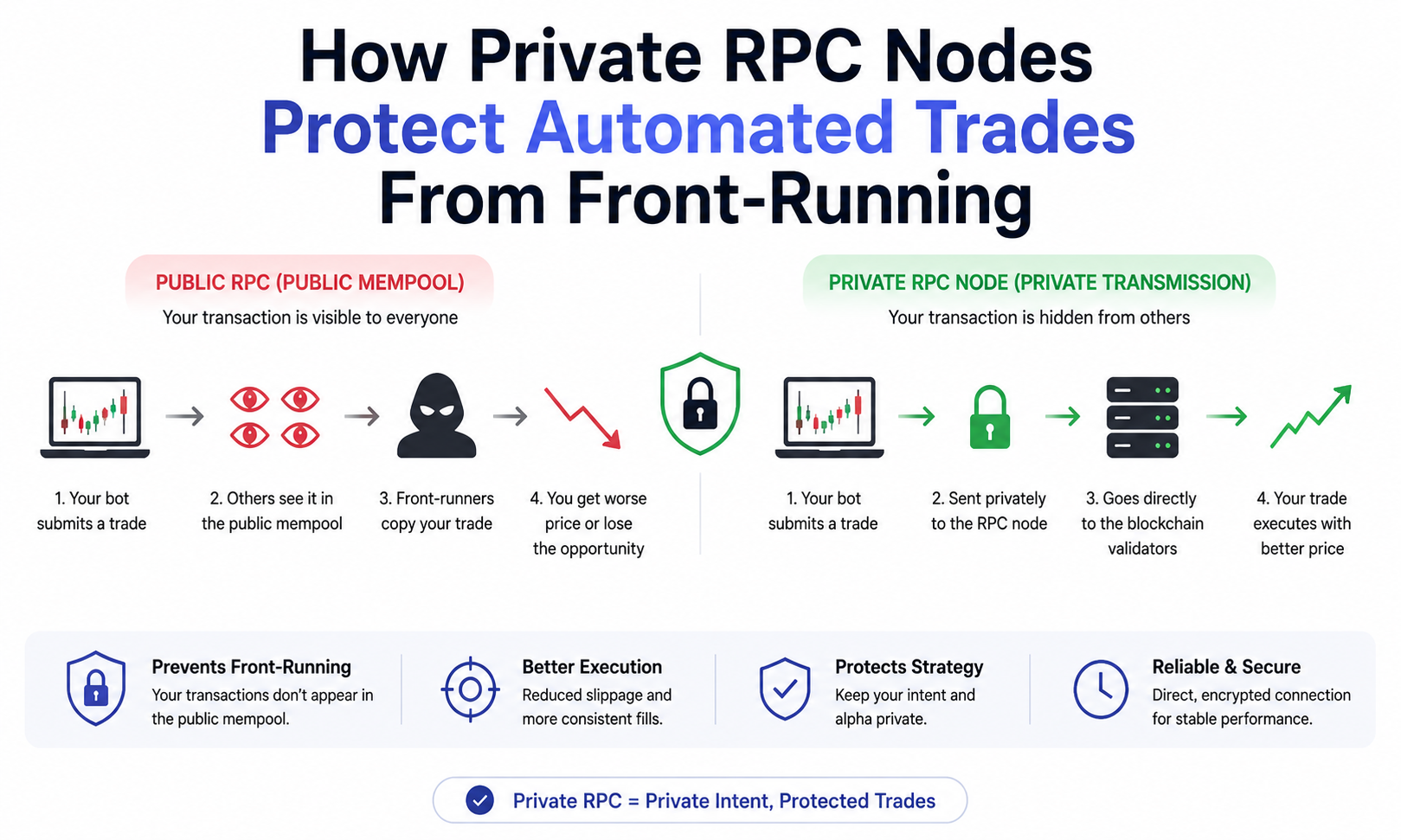
Public RPC nodes are shared by thousands of users. Transactions submitted through these endpoints often become visible to anyone monitoring the public mempool. This transparency creates opportunities for front-runners to observe and exploit pending orders.
A private RPC node works differently. Instead of broadcasting your transaction to the public network immediately, it routes the transaction through a private channel. This significantly reduces visibility and limits the ability of third parties to react before confirmation.
READ ALSO
How Private RPC Nodes Prevent Front-Running
The primary advantage of a private RPC node is transaction privacy. By preventing transactions from appearing in public mempools, it removes one of the key pieces of information front-runners rely on.
Rather than exposing your trade to the entire network, the transaction is delivered directly to validators or trusted relays. Since attackers never see the transaction before execution, they cannot easily position their own trades around it.
This doesn't completely eliminate all forms of MEV, but it significantly reduces the likelihood of common attacks such as sandwiching and opportunistic front-running. For automated traders, this protection can have a measurable impact on long-term performance.
The Benefits of Private RPC Nodes
Using a private RPC offers benefits that extend beyond simple front-running protection. Many of these advantages directly contribute to better execution quality and more reliable automated trading.
Some of the most important benefits include:
- Greater transaction privacy
- Lower latency
- Higher success rates
- Reduced MEV exposure
- More predictable execution
Together, these improvements create a more stable trading environment. Instead of competing against mempool bots, traders can focus on optimizing strategies and managing risk.
Over time, these advantages can become a significant competitive edge, particularly for active DeFi participants.
Private RPCs vs Public RPCs
The difference between public and private RPC infrastructure is substantial. Public endpoints are designed for accessibility and convenience, while private endpoints prioritize performance and security.
Public RPCs often experience congestion because they serve a large number of users simultaneously. During periods of high demand, transaction delays and inconsistent performance become more common. This can create problems for trading systems that rely on fast execution.
Private RPCs, by contrast, are optimized for speed and reliability. Since they handle fewer users and often provide dedicated resources, they typically deliver better performance under demanding market conditions.
For automated traders, even small improvements in execution quality can have meaningful long-term effects.
READ ALSO
- How to Use Flash Accounting Features to Minimize Overall Smart Contract Execution Gas Overhead
- How to Hedge Your Position Value While Waiting for Multi-Signature Bridge Transactions to Clear
- How do cross-chain aggregators calculate the most cost-efficient route for massive spot swaps?
- How to Calculate Uniswap V3 Impermanent Loss Risk (2026 Guide)
Managed Private RPC Services
Most traders choose managed private RPC providers rather than operating their own infrastructure. These services offer dedicated endpoints without requiring users to maintain servers or blockchain clients.
Popular providers include:
- Alchemy
- QuickNode
- Blockdaemon
- Chainstack
Managed services are attractive because they combine ease of use with professional infrastructure. Users simply obtain an endpoint, integrate it into their trading systems, and begin routing transactions privately.
This approach allows traders to benefit from private transaction routing without needing deep technical expertise.
Self-Hosted Private RPC Nodes
For advanced users, self-hosting remains an option. Running your own node provides maximum control over infrastructure and transaction flow. It also removes reliance on third-party providers.
However, self-hosting comes with significant responsibilities. Maintaining a full blockchain node requires hardware resources, ongoing monitoring, software updates, and security management. The setup process can be time-consuming and technically demanding.
While institutional traders and sophisticated operators may find these trade-offs worthwhile, most individual users achieve sufficient performance through managed private RPC services.
Solana, Jito Tips, and Transaction Prioritization
On Solana, transaction ordering works differently than on Ethereum, but front-running risks still exist. The ecosystem has developed specialized tools to help traders improve execution quality and transaction prioritization.
Jito tips allow users to provide additional incentives to validators for transaction inclusion. By attaching these tips, traders can increase the likelihood that their transactions receive priority treatment during periods of congestion.
Dynamic priority fees provide another layer of optimization. These fees adjust based on network conditions, helping users secure faster execution without consistently overpaying. Together, these mechanisms have become essential tools for serious Solana traders.
Private Transaction Routing on Ethereum
Ethereum has developed its own ecosystem of private transaction infrastructure. Services such as Flashbots have become central to how many traders avoid public mempool exposure.
Rather than submitting transactions directly to the public network, users can send them through specialized relays. These relays forward transactions privately to block builders, preventing most forms of front-running.
This model has become increasingly popular because it improves execution quality while preserving many of the benefits of decentralized trading. For larger transactions, the reduction in MEV losses can easily justify the additional complexity.
Best Practices for Automated Traders
Simply using a private RPC is not enough. To maximize protection, traders should combine private infrastructure with broader security and execution practices.
Consider implementing:
- Multiple RPC providers
- Automatic failover systems
- Secure API key management
- Transaction monitoring
- Performance analytics
These measures improve reliability while reducing operational risk. If one endpoint experiences issues, your trading system can automatically switch to another provider without interrupting execution.
Building redundancy into your infrastructure is often just as important as improving speed.
Common Mistakes to Avoid
Many traders assume that once a private RPC is configured, their problems are solved. In reality, poor implementation can undermine many of the benefits these services provide.
Common mistakes include:
- Exposing API credentials
- Relying on a single provider
- Ignoring latency monitoring
- Failing to update configurations
- Overlooking transaction analytics
These issues can reduce effectiveness and create vulnerabilities that attackers may exploit. Regular monitoring and maintenance remain essential even when using private infrastructure.
Treating private RPCs as part of a broader security strategy produces the best results.
Are Private RPC Nodes Worth It?
For occasional users making small transactions, a private RPC may not provide a noticeable benefit. The costs and setup requirements may outweigh the potential savings.
For automated traders, however, the equation is very different. Frequent transactions create more opportunities for front-running and MEV extraction. Even small improvements in execution quality can accumulate into significant gains over hundreds or thousands of trades.
This is why many professional traders now view private transaction routing as a standard requirement rather than an optional enhancement. In competitive markets, protecting transaction flow has become an essential part of maintaining profitability.
Conclusion
Front-running remains one of the most persistent challenges facing automated traders in 2026. As blockchain ecosystems become faster and more sophisticated, attackers continue developing new ways to exploit public transaction visibility. Private RPC nodes provide an effective defense by keeping transactions hidden from public mempools until they are ready to be confirmed.
Whether you choose a managed provider or operate your own infrastructure, private transaction routing can significantly improve execution quality and reduce exposure to MEV attacks. Combined with strong operational practices and ongoing monitoring, private RPCs help create a more secure and efficient environment for automated trading. For anyone running bots, arbitrage systems, or high-frequency strategies, they have become one of the most important tools available in modern Web3 trading.